Beginning of the War Crime and Destruction
Although Amhara and Tigray people have deeply built-in social, historical, and cultural ties, TPLF-led Tigray invading forces carried out ruthless inhuman mass atrocities, lootings, and destruction of Amhara people. Beginning on November 03, 2020, discriminatory and inhuman killings of the Ethiopian army members and in particular Amhara soldiers, Tigray invading forces uncovered their unfathomable hatred of Amhara people in areas which they temporarily occupied during the war.
Civilian Killings, Rape and Schools as Mass Funeral Places
This historically unparalleled war crime intentionally targeted civilians, women, public institutions, factories, and agriculture centers. Civilians were mercilessly killed; women were raped in daylight and in front of their children; wives were raped in front of their husbands and children, and schools were used as mass funeral places.
Destruction of Infrastructure
The Tigray invading forces damaged and looted
- 31 hospitals, 1156 schools, 5 teachers colleges, 3 federal public universities (Wollo University, Woldia University and Mekdela Amba Universities),
- 3476 Agricultural institutions (farmer training center, animal and plant health clinic, nurseries, cooperatives and unions, agricultural colleges, Agricultural Research centers, tissue culture, and soil laboratories, animal ranches and multiplication centers, and others),
- 850 industries, 1775 investments, and a significant number of different scale business centers, enterprises, and infrastructures.
The invading forces also destroyed invaluable materials when they could not loot and move them to Tigray. The invading forces cynically demolished ICT infrastructure, agriculture laboratories, and electricity supply routes with the intent of putting the Amhara people in impoverished poverty and hopelessness. The atrocities and destructions were not only intended to cause physical and economic destruction but also to incur severe socio-emotional harm and psychological trauma.
Purpose of the Website
- Ethiopian people and the world would get empirically validated evidence on the extent of destruction and war crime committed by the invading forces in the Amhara region and take an objective view of the atrocities committed on ordinary civilians and public and government resources.
- It helps to give reasonable evidence-based prioritization to design physical, psychosocial, and mental rehabilitation and reconstruction interventions.
- It also helps to teach younger and future generations about the effect of unjustified war on civilians and social and economic resources.
- It helps to initiate further research on the medium and long-term effects of the war in the Amhara region.
Scientific Documentation of the War Crime and the Scope of the Study
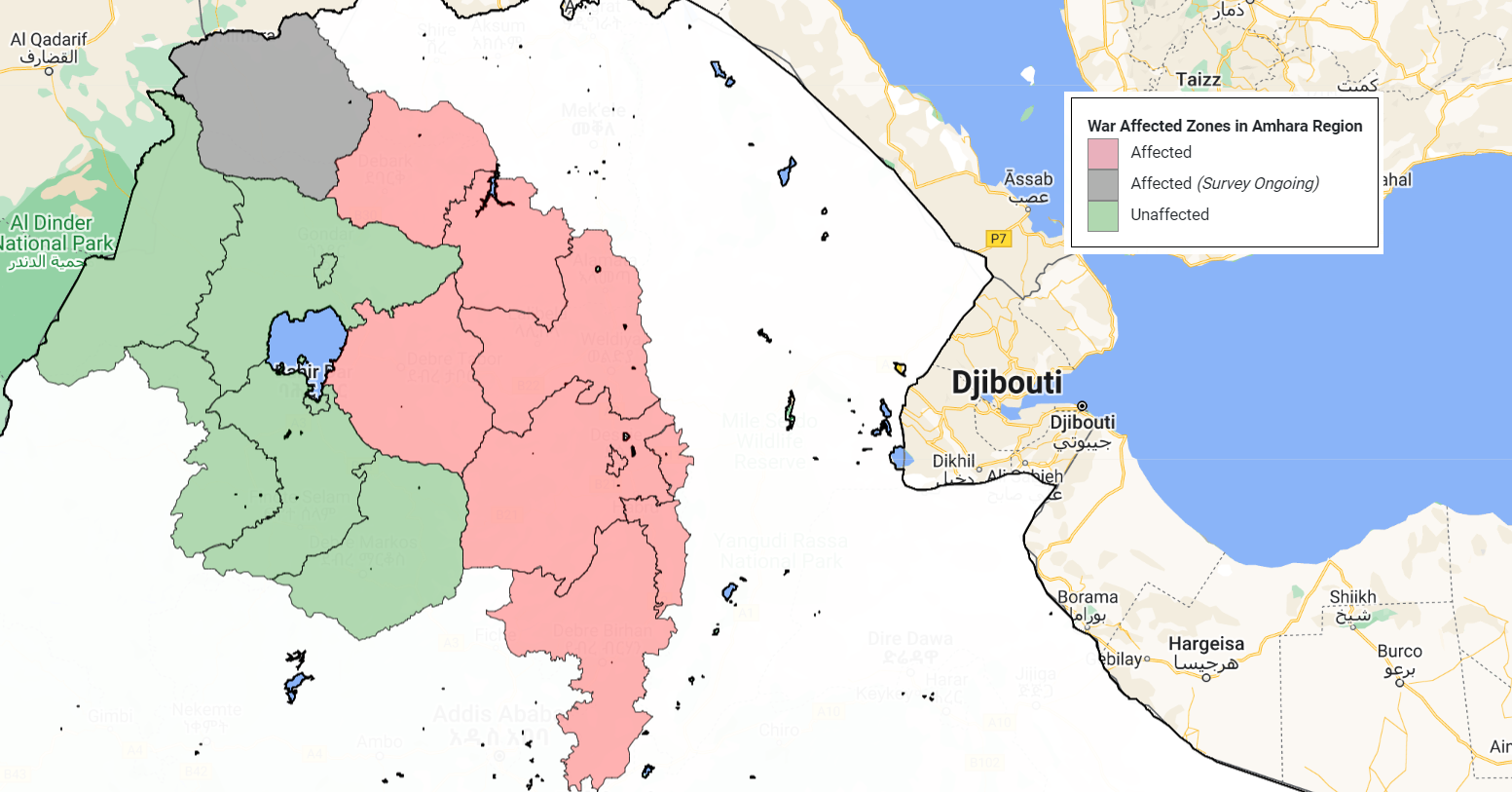
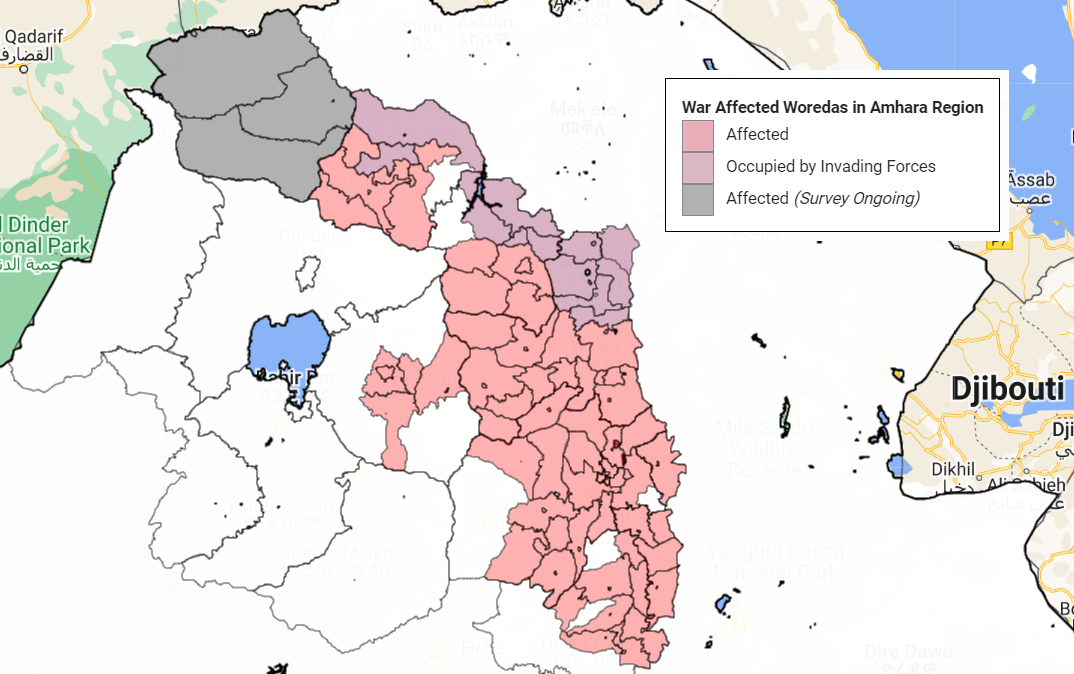
The atrocities, destructions, and lootings are empirically researched, recorded, and compiled immediately after the invading forces retreat. Virtually all freed-up areas of the Amhara region were included in the study, except Wolkait where the study is ongoing, and districts and Kebeles which are still under the invading forces. Experts from different disciplines observed, interviewed, recorded, and studied the effect of the Tigray invading forces on the human, social, and economic resources of the Amhara region. A team of independent experts from ten higher learning institutions based in the Amhara Region, Amhara Scholars Council, and the Amhara Region Statistics Authority gathered data for two months and the data were analyzed and interpreted following scientific standards. Studies by various regional sectors and federal ministries were also used to validate and harmonize the extent and type of destruction. Amhara regional bureaus organized a team of experts to collect data on the extent and type of destruction. The cost of total destruction was calculated by taking current prices for destroyed buildings, facilities, and agricultural resources. The full extent of this study is published in a book.
Developing the Geo-Spatial Website
- Geo-spatial data further expand people’s understanding of the extent of destruction and a war crime.
- It also considerably enhances the reliability of the data as the documentation incorporates actual destroyed infrastructure and institutions spatially.
- Geospatial data also enhances responsibility and accountability for rehabilitating and reconstructing destroyed institutions and public resources. This webpage presents accessible data on the extent of the destruction.
Although the study was conducted right after the retreat of the Tigray invading forces, it is highly likely that some data were not captured due to logistical reasons. On top of this, the webpage will be updated to include stories on massacres, rapes, and other forms of inhuman acts.
The webpage presents the destructions in the form of spatial maps with referenced pictures, photo slides by thematic areas, storytelling videos, and estimated costs of the destruction.